AI engineering • Cloud • Software
Engineering AI that works. Building cloud platforms that scale.
V Solutions partners with ambitious businesses to design, build, integrate and operate production-ready AI agents, enterprise AI applications, cloud platforms and modern software systems.
- Headquartered in Troy, Michigan
- Engineering hub in Hyderabad, India
- Serving organizations across the US and Canada
How the pieces fit — choose a focus
- Users & channelsWeb appsPortalsChat & Teams
- AI agents & applicationsAgentsAssistantsAI features
- Tools & enterprise APIsMCP serversERP · CRM · ITSMInternal APIs
- Data & retrievalDocumentsVector searchDatabases
- Cloud platformKubernetesTerraformCI/CD
Security · Observability · Governance
AI applications grounded in your data
Assistants, search and document tools that answer from approved sources, respect existing permissions and are measured before and after launch.
- Retrieval from approved sources
- Answers with citations
- Quality evaluated continuously
- Users & channelsWeb appsPortalsChat & Teams
- AI agents & applicationsAgentsAssistantsAI features
- Tools & enterprise APIsMCP serversERP · CRM · ITSMInternal APIs
- Data & retrievalDocumentsVector searchDatabases
- Cloud platformKubernetesTerraformCI/CD
Security · Observability · Governance
Agents that act — within the limits you set
Agents plan a task, call only the tools and APIs they're allowed to, pause for human approval on consequential actions, and log every step.
- Scoped tool permissions
- Human approval gates
- Full audit trail
- Users & channelsWeb appsPortalsChat & Teams
- AI agents & applicationsAgentsAssistantsAI features
- Tools & enterprise APIsMCP serversERP · CRM · ITSMInternal APIs
- Data & retrievalDocumentsVector searchDatabases
- Cloud platformKubernetesTerraformCI/CD
Security · Observability · Governance
The platform everything runs on
Infrastructure defined in code, releases through tested pipelines, and observability that shows problems before customers do.
- Terraform and Kubernetes
- CI/CD with security gates
- SLOs, monitoring and cost visibility
Our engineering
One engineering team. Four core disciplines.
Choose a discipline to see how the work flows, what we deliver and the problems it solves.
Engineers embedded with your team who take a defined business problem from discovery to production software in your environment.
- Problem discovery
- Rapid prototype
- Integration
- Production deployment
- Handover
What we deliver
- Workflow discovery with users and domain experts
- Prototypes tested on real examples
- Integration with enterprise systems
- Deployment, monitoring and handover
Challenges it addresses
- An AI pilot that never reached production
- A process split across systems that don't talk to each other
Typical technology
- Python
- TypeScript
- LLM APIs
- REST & GraphQL
- Kubernetes
Governed agents that complete defined workflows by calling approved tools — with permissions, approvals and audit trails built in.
- Task
- Planning
- Approved tool calls
- Human approval where required
- Result & audit trail
What we deliver
- Single- and multi-agent workflows
- Tool calling and MCP integrations
- Human-in-the-loop approvals
- Evaluation and tracing
Challenges it addresses
- Repetitive multi-step work across several systems
- Assistants that can explain a task but can't do it
Typical technology
- LangGraph
- MCP
- OpenAI
- Anthropic Claude
- OpenTelemetry
Enterprise AI applications that answer from your own knowledge — grounded, permission-aware and measured for quality.
- Enterprise documents
- Retrieval
- Context assembly
- LLM response
- Evaluation & monitoring
What we deliver
- RAG pipelines and knowledge assistants
- Document intelligence
- AI search
- Private and enterprise deployments
Challenges it addresses
- Knowledge locked in documents nobody can find
- AI answers nobody can verify
Typical technology
- Azure OpenAI
- AWS Bedrock
- pgvector
- OpenSearch
- LlamaIndex
Cloud platforms, delivery pipelines and reliability engineering across AWS, Azure and Google Cloud.
- Git commit
- CI pipeline
- Tests & security gates
- Infrastructure & deployment
- Observability
What we deliver
- Architecture and migration
- Terraform, Docker and Kubernetes
- CI/CD and GitOps
- SRE, observability and FinOps
Challenges it addresses
- Releases that need a change window and a specialist
- Cloud spend nobody can explain
Typical technology
- AWS
- Azure
- Google Cloud
- Terraform
- Argo CD
Forward deployed engineering
Your hardest engineering problems. Solved alongside your team.
Forward deployed engineers work directly with your people and domain experts to understand the workflow, integrate the systems you already run, and deliver production software in your environment.
Not staff augmentation. A forward deployed team owns a defined problem end to end — from discovery to a production system your team can run — working with you throughout.
Prototype to production
- Objective
- Understand the real problem and what success looks like.
- Engineering activity
- Working sessions with users and domain experts; map the workflow, the data, the systems involved and the exceptions.
- Deliverable
- A problem statement, a workflow map and agreed success criteria.
- Objective
- Prove or disprove the riskiest assumption quickly.
- Engineering activity
- Build a thin, working slice and test it against real examples from your business.
- Deliverable
- A working prototype and a short findings note with the recommended path.
- Objective
- Connect the solution to the systems it depends on.
- Engineering activity
- Integrate APIs, identity and data sources, following your security model and change process.
- Deliverable
- An integrated build running in a staging environment.
- Objective
- Make it safe and dependable to run.
- Engineering activity
- Automated tests, AI evaluations where relevant, security review, observability and failure handling.
- Deliverable
- Test and evaluation results, dashboards and runbooks.
- Objective
- Release without surprises.
- Engineering activity
- Staged rollout in your environment, with monitoring in place and a rehearsed rollback.
- Deliverable
- A production deployment and its documentation.
- Objective
- Leave your team fully in control.
- Engineering activity
- Pairing, walkthroughs and documentation; optional continued engineering support.
- Deliverable
- Handover sessions and an ownership plan.
Customer-facing engineering
Engineers work with your users and domain experts, not from a specification.
Discovery and prototyping
Short cycles that test the riskiest assumption on real examples first.
AI and application integration
LLM features and agents built into the applications people already use.
Enterprise APIs
Connections to ERP, CRM, ITSM and internal services using your identity model.
Production deployment
Released into your cloud or data center through automated pipelines.
Testing and observability
Automated tests, evaluations, logs, metrics and alerts from the start.
Security and governance
Least-privilege access, data-handling rules and review before go-live.
Knowledge transfer
Documentation, pairing and runbooks so your team owns the result.
- Python
- TypeScript
- LLM APIs
- LangGraph
- REST & GraphQL
- PostgreSQL
- Docker
- Kubernetes
- Terraform
Agentic AI
Move beyond answers. Build AI that can do the work.
Governed agents complete defined tasks through approved tools and enterprise integrations. Reliability comes from scoped permissions, evaluation and human oversight — not unlimited autonomy.
Illustrative workflow — an example of how a governed agent system works, not a live system.
A request arrives
A finance user asks to change a supplier's payment terms from 30 to 45 days. The orchestrator breaks the task into steps and decides which agents to involve.
Runs with the requesting user's identity — never broader access.
Checks the policy
Retrieves the approved payment-terms policy and the supplier's contract clause, and cites both.
Reads only from approved, permission-filtered sources.
Queries the system of record
Looks up the supplier's current terms and open invoices in the ERP through a read-only tool.
Read-only tool with a scoped credential.
Prepares the change
Drafts the update and a summary of its effect on open invoices. Nothing is written yet.
Write tools are disabled until approval.
Approves or rejects
A finance approver reviews the proposed change, the sources and the reasoning, then approves or rejects it.
Consequential actions always need a person.
Everything is recorded
The request, each agent's steps, tool calls, sources, the approval and the final result are logged together.
Any outcome can be traced and explained.
- Single-agent and multi-agent systems
- Tool calling
- MCP integrations
- Retrieval-augmented generation
- Enterprise API integrations
- Human-in-the-loop approvals
- Access control
- Evaluation
- Observability
- Deployment and operations
Generative AI
Turn enterprise knowledge into useful AI applications.
Where agentic AI acts, generative AI informs: assistants, search and document tools that answer from your own knowledge — with access control, privacy and quality evaluation built in.
Documents and records are collected from approved sources — SharePoint, file shares, wikis, ticketing and databases — along with their access permissions.
Engineering decisions: Connectors, update schedules and which sources are in scope.
Files are parsed (including tables and scanned pages) and split into passages that keep headings and context together.
Engineering decisions: Chunk size and structure tuned to each document type.
Passages are embedded and indexed so a question can find the most relevant ones by meaning, often combined with keyword search.
Engineering decisions: Embedding model, vector store and hybrid search settings.
Retrieved passages are filtered to what the user is allowed to see, re-ranked and assembled into the model's context.
Engineering decisions: Permission filtering, re-ranking and context limits.
The model answers using only the supplied context and the application's instructions.
Engineering decisions: Model choice, prompts, guardrails and cost controls.
The answer cites its sources, or says it doesn't know when the sources don't support one.
Engineering decisions: Citation format and refusal behaviour.
Answers are scored against test questions before release and monitored with user feedback afterwards.
Engineering decisions: Evaluation sets, quality thresholds and dashboards.
What it's used for
- Enterprise knowledge assistants
- Document intelligence
- Internal search
- RAG applications
- AI-powered workflow interfaces
- Customer support assistants
- Data extraction and summarization
Built in, not bolted on
- Retrieval respects existing document permissions
- Private model endpoints where data must stay in your tenant
- Quality measured against real questions before launch
Cloud, DevOps & SRE
Cloud infrastructure engineered for delivery, reliability and scale.
AWS, Microsoft Azure and Google Cloud — designed, automated and operated as one practice. Service levels are agreed per engagement, never assumed.
- Assess
- Architect
- Provision
- Deploy
- Observe
- Optimize
Target architectures and migrations planned workload by workload on AWS, Microsoft Azure or Google Cloud.
- Current state
- Target design
- Landing zone
- Migration waves
- Workload assessment and landing zones
- Rehost, replatform or refactor per workload
- High availability and disaster recovery designs
- Rehearsed cutovers with rollback plans
- AWS
- Microsoft Azure
- Google Cloud
Pipelines that build, test, scan and deploy every change the same way — so releases become routine.
- Commit
- Build & test
- Security scan
- Deploy
- CI/CD with automated tests
- GitOps deployments
- Blue-green and canary releases
- Automated rollback on failed health checks
- GitHub Actions
- GitLab CI
- Azure DevOps
- Argo CD
- Flux
Containerized workloads on managed Kubernetes, designed for security, autoscaling and painless upgrades.
- Container image
- Registry
- Cluster
- Autoscaled service
- Cluster design on EKS, AKS or GKE
- Helm charts and GitOps workflows
- Autoscaling and right-sized resources
- Network policies and RBAC
- Docker
- Kubernetes
- Helm
- Karpenter
Reliability treated as engineering: agreed objectives, useful alerts and runbooks people can follow.
- Instrument
- Measure SLOs
- Alert
- Learn
- Service-level objectives and error budgets
- Metrics, logs and traces
- Actionable alerting and on-call runbooks
- Blameless incident reviews
- Prometheus
- Grafana
- OpenTelemetry
- CloudWatch
- Azure Monitor
Security and governance built into the platform and the pipeline rather than reviewed at the end.
- Identity
- Policy checks
- Secrets
- Audit logs
- Least-privilege identity and access
- Managed secrets and encryption
- Policy as code in the pipeline
- Network segmentation and private connectivity
- IAM / Entra ID
- Key Vault / Secrets Manager
- OPA
- Terraform
Cloud spend made visible and owned, then reduced without trading away reliability.
- Tag & allocate
- Analyze
- Right-size
- Review monthly
- Cost allocation by team or product
- Right-sizing and autoscaling
- Commitment and storage-tier planning
- Cleanup of idle resources
- AWS Cost Explorer
- Azure Cost Management
- Kubecost
How we think
From incident to insight.
Pick a problem to see how our engineers reason from symptoms to a verified fix.
Simulated demonstration — prewritten scenarios for illustration. Nothing here connects to a real system.
Observed symptoms
p95 latency on one API endpoint has roughly tripled. Error rates are flat. It started shortly after a deployment.
Evidence to collect
- Latency by endpoint and release version
- Traces for the slowest requests
- Database query timings and plans
- The diff of the recent deployment
Diagnostic reasoning
Only one endpoint is slow and errors haven't moved, which points to a change in that code path rather than the infrastructure. Traces show the time is spent waiting on one database query that the new release added — and that query isn't using an index.
Remediation
- Roll back or switch off the change behind its feature flag
- Add the missing index through a reviewed migration
- Redeploy the fix
Validation
- p95 back within its objective for a sustained period
- The query plan now uses the index
- A latency regression test and alert are added
Observed symptoms
Pods for one service restart every few minutes. Their last state shows OOMKilled with exit code 137.
Evidence to collect
- kubectl describe pod (last state and exit code)
- Container memory usage against its limit
- Recent changes to limits, traffic or runtime settings
- A heap profile from a running pod
Diagnostic reasoning
OOMKilled means the container exceeded its memory limit. Memory climbs steadily under normal traffic instead of spiking with load, which suggests the runtime heap is sized above the container limit or there is a leak — not a traffic surge.
Remediation
- Align the runtime heap settings with the container limit
- Set requests and limits from observed usage
- Fix the leak if the heap profile confirms one
Validation
- No restarts across a full traffic cycle
- Memory plateaus below the limit
- An alert fires when memory approaches the limit
Observed symptoms
The pipeline fails at the deploy step because the rollout times out. The previous version is still serving traffic.
Evidence to collect
- Pipeline logs for the failed job
- kubectl rollout status and events for the new pods
- Readiness probe results
- The manifest diff for this release
Diagnostic reasoning
The new pods never become ready, and their events show the readiness probe failing. The release moved the health endpoint to a new path, but the probe in the manifest still checks the old one.
Remediation
- Correct the probe path in the manifest (or restore the old endpoint)
- Re-run the pipeline while the previous version keeps serving
- Add manifest validation to the pipeline
Validation
- The rollout completes and probes pass
- Smoke tests pass against the new version
- The validation step catches the same mistake in a test branch
Observed symptoms
An agent's “create ticket” step has started failing. Users see a generic error and the task stops.
Evidence to collect
- Agent traces: prompt, chosen tool and arguments, tool response
- The ticketing API's error logs
- Recent changes to tool schemas, prompts or model version
Diagnostic reasoning
The traces show the model sending a priority value the ticketing API now rejects. The API's allowed values changed, but the tool description given to the model wasn't updated, so the agent keeps generating the old value.
Remediation
- Update the tool definition with the allowed values
- Validate tool arguments before calling the API
- Return a structured error the agent can recover from
Validation
- Replaying the failed traces now succeeds
- Tool-call success rate returns to normal
- These cases are added to the agent's regression suite
Outcomes
Engineering decisions that connect to business outcomes.
Shorter delivery cycles
Automated pipelines and small, frequent releases replace long change windows.
CI/CD · GitOps
More reliable deployments
Tests, security gates and progressive rollouts catch problems before customers do.
Quality gates · Canary releases
Visible cloud costs
Spend allocated to the teams and products that create it, and reviewed regularly.
Tagging · FinOps reviews
AI that fits real systems
Agents and assistants connected to the tools people already use, with controls in place.
Integration · Governance
Less manual operational work
Routine steps automated, with people kept for judgment and approvals.
Automation · Agents
More maintainable software
Clear architecture, typed code and tests that make change cheaper.
Architecture · Testing
Stronger operational control
Observability, audit trails and runbooks that make systems explainable.
SRE · Audit trails
Services
Four core disciplines, two supporting services.
Designed, built and supported by the same engineering team.
Forward Deployed Engineering
Engineers who work directly with your teams to turn a business problem into production software running in your environment.
- Problem discovery with your users
- Prototype to production
- AI and enterprise system integration
Agentic AI Solutions
AI agents that complete defined workflows using approved tools and data, with human approvals, permissions and audit trails.
- Tool-calling and multi-agent workflows
- MCP and enterprise API integration
- Guardrails, approvals and audit trails
Generative AI Solutions
LLM-powered applications grounded in your own data: knowledge assistants, AI search, document intelligence and content generation.
- RAG pipelines and knowledge assistants
- Document intelligence and AI search
- Evaluation and hallucination reduction
Cloud & DevOps Engineering
Cloud architecture and migration, infrastructure as code, Kubernetes, CI/CD and SRE across AWS, Azure and Google Cloud.
- Cloud architecture and migration
- Terraform, Kubernetes and CI/CD
- Observability, SRE and cost optimization
Supporting services
Web & Application Development
Custom websites, enterprise web applications, SaaS products and APIs — from architecture and UX through testing, deployment and support.
Virtual Desktop Infrastructure (VDI) Services
Virtual desktop and application delivery on Azure Virtual Desktop, Windows 365 and Citrix, integrated with your identity and endpoint management.
How an engagement runs
From the first technical conversation to production.
Six stages, each with something concrete you receive. How we work
- What happens
- A technical conversation about your goal, constraints, systems and users.
- You receive
- A clear problem statement
- What happens
- Agree what will be built, how success is measured and what is out of scope.
- You receive
- Scope and acceptance criteria
- What happens
- Design the solution and the path to production, including security and operations.
- You receive
- An architecture diagram
- A delivery plan
- What happens
- Iterative delivery with regular demos, code review and automated tests.
- You receive
- A working prototype
- The production implementation
- What happens
- Test function, performance, security and — for AI — quality against agreed evaluations.
- You receive
- Test and evaluation results
- What happens
- Release into your environment, monitor, and improve from real usage.
- You receive
- Deployment documentation
- Runbooks and handover
Engineering proof
Illustrative engineering scenarios
Examples of the problems we take on across our six services — illustrations of the approach, not descriptions of specific client projects. See our case studies
Taking an AI pilot into production
- Challenge
- A support assistant works in demos but isn't connected to ticketing or approved for customer data.
- Approach
- Embedded engineers map the workflow, ground the assistant in approved knowledge, integrate ticketing and add evaluation and monitoring.
IT ticket triage agent
- Challenge
- Routine tickets wait in a queue while engineers gather the same diagnostics every time.
- Approach
- An agent classifies tickets, runs read-only diagnostics, proposes a fix and asks an engineer to approve any change.
Policy assistant for staff
- Challenge
- Employees search several portals for policies and still aren't sure they found the current version.
- Approach
- Retrieval over approved policy documents, answers that cite the exact section, and access that follows existing permissions.
From release weekends to routine deploys
- Challenge
- Monthly releases need a change window, a checklist and the one engineer who knows the steps.
- Approach
- Environments defined in Terraform, automated tests in CI, and GitOps deployments with canary releases and rollback.
Self-service customer portal
- Challenge
- Customers email for order status and documents, and staff re-key answers from three systems.
- Approach
- A portal with single sign-on, connected to the ERP and document store through documented APIs.
Secure access for contractors
- Challenge
- Contractors need a handful of internal applications without being issued company laptops.
- Approach
- An Azure Virtual Desktop host pool publishing only those apps, with conditional access, FSLogix profiles and autoscaling.
Insights
Practical guidance from our engineers and strategists

AI in VDI and Virtual Workspaces: 2026 Trends for Secure Remote Work with V Solutions Inc.
In 2026, AI in VDI and workspaces is fundamentally reshaping how organizations deliver secure, productive remote work environments. As hybrid and distributed teams become the…
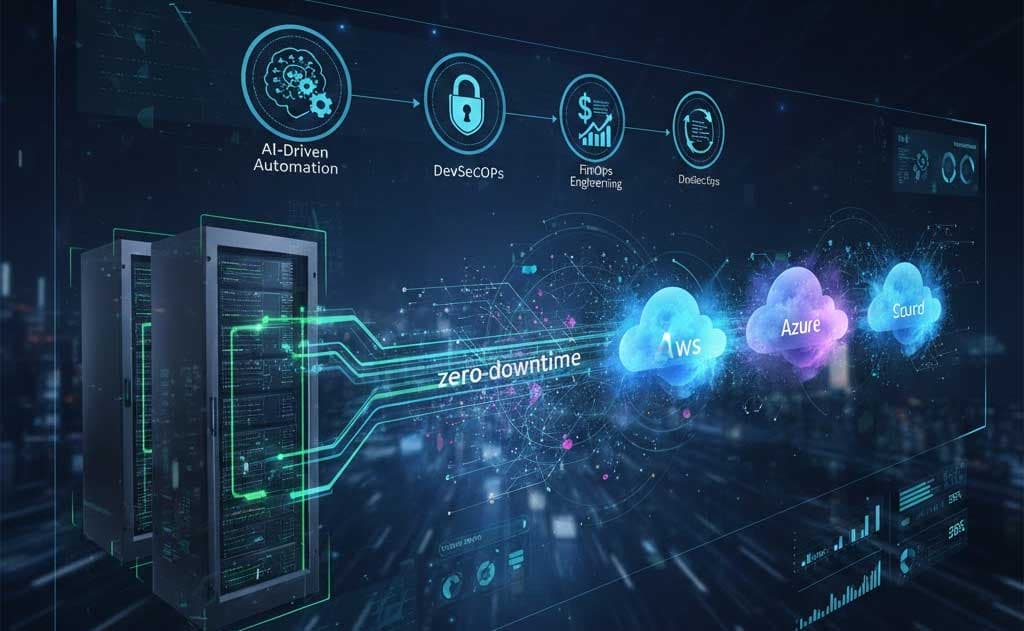
Cloud Migration Best Practices 2026: Achieving Zero-Downtime DevOps Transitions with V Solutions Inc.
In 2026, cloud migration best practices have evolved into a critical business imperative, driven by the explosive growth of AI workloads, hybrid/multi-cloud environments, and the…
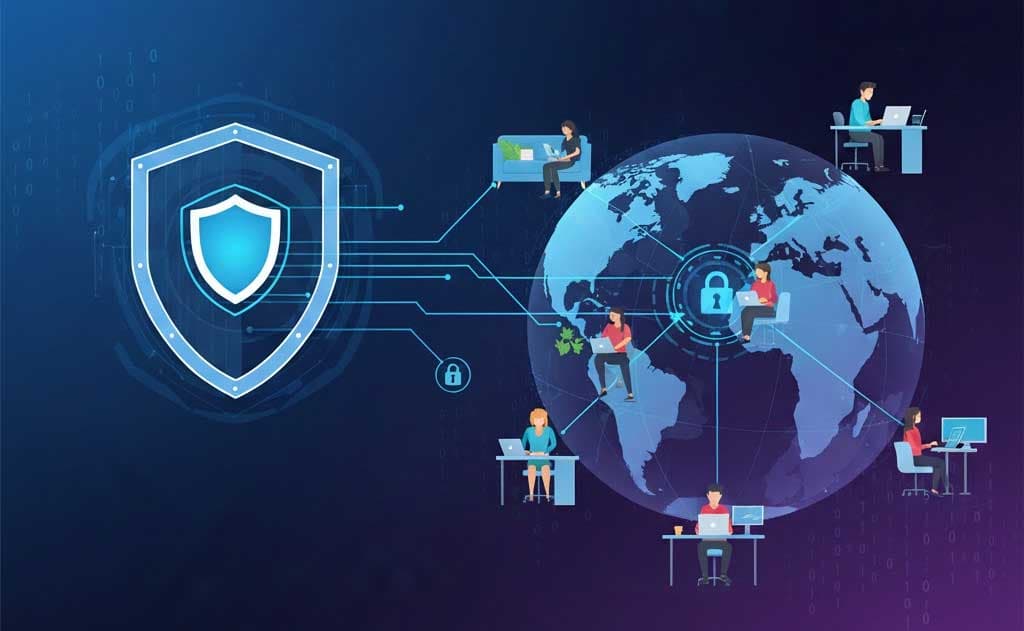
Citrix Virtual Apps 2026: Bolstering Remote Desktop Security for the Hybrid Workforce
In 2026, Citrix virtual apps 2026 solutions continue to lead the way in secure virtual desktop infrastructure (VDI) and desktop-as-a-service (DaaS), empowering organizations to…
Get in touch
Let's solve a real engineering problem.
Tell us what you are building, modernizing, automating or trying to fix. Our team will help you identify the right engineering approach.